

Get more from the water
you already use.
RESULTS
UpTerra results can appear throughout the growing season, from changes in water and root-zone conditions to crop performance, nutrient uptake, and efficiency over time.
The value is an investment beyond a single season, with resource savings creating cumulative benefits and cost reductions year after year.
Explore the studies below to see where these results have been observed and how they were measured.

SAVE
WATER


MITIGATE
SALINITY


STRENGTHEN
SOIL HEALTH


BOOST
NUTRIENT UPTAKE

MAXIMIZE
CROP PERFORMANCE

20% less irrigation
with 8.5% higher corn-silage yield
UpTerra-treated acreage received 4.54 acre-feet of irrigation per acre compared with 5.67 acre-feet per acre in the control.

Howard County, Texas | 500-acre commercial comparison

14 paired crop observations | p = 0.017
14.2% less water
across three metered crop seasons
Across five treated and five matched control fields, UpTerra-treated fields received 689.3 million gallons of irrigation compared with 803.3 million gallons in controls.
Yield maintained with less water
During the complete 2025 forage rotation, treated fields produced 56.60 tons/acre vs. 56.51 tons/acre in controls while receiving 12% less irrigation.
Texas Panhandle | 1,204 acres | Matched fields

Plant hydration maintained or improved under controlled conditions
UpTerra-treated water was applied at 75% ET compared with conventional water at 100% ET.
Root-zone water availability remained relatively close to the fully irrigated control, while crop productivity was maintained under reduced irrigation.
University of Nevada, Reno Extension | Controlled study | 2026
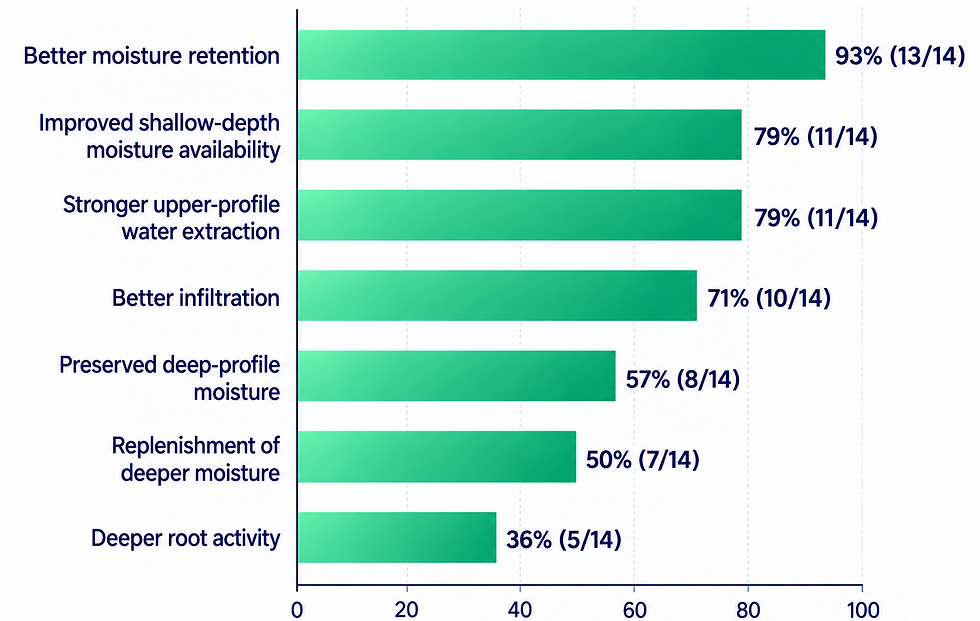
Multi-site field observations | Multiple crops and soil types
Better moisture retention observed in 13 of 14 commercial fields
Across 14 commercial fields, testing found improved, recurring soil-moisture responses.
These results represent the frequency of observed patterns across commercial fields.
Multi-season Haney Soil Testing | Selected soil biological + nutrient indicators
With ~9.5% greater
adjusted grain yield
A commercial grain-corn evaluation found approximately 9.1% less irrigation water alongside approximately 9.5% greater yield after adjustment for non-representative field areas.

Kansas | Flood-irrigated grain corn
Crop performance maintained under reduced irrigation
Pistachio greenhouse studies reported more than 30% water savings, with improved plant vigor or no negative impact under reduced-water treatment.
See the difference in the video.

MARI Agricultural Research Institute | Pistachio greenhouse research


Fields grown with UpTerra have used up to 20% less irrigation water.*
Metered field studies, controlled research, and multi-site observations show reduced irrigation alongside maintained crop productivity and favorable root-zone moisture responses.

SAVE WATER

In a single season, UpTerra-treated fields have shown up to 52% lower sodium accumulation in the root zone.*
Matched-field, controlled, and commercial studies show favorable changes in sodium accumulation, chloride, SAR, EC, and soluble salts under UpTerra treatment.

MITIGATE SALINITY

Significantly less sodium accumulation across matched commercial fields
Across three matched treated-control field pairs, mean sodium accumulation was +16.0 ppm in UpTerra-treated soils compared with +33.3 ppm in controls.
All three matched field pairs favored UpTerra
Mean magnesium accumulation was also significantly lower.
Texas Panhandle | Matched fields | 2025–2026
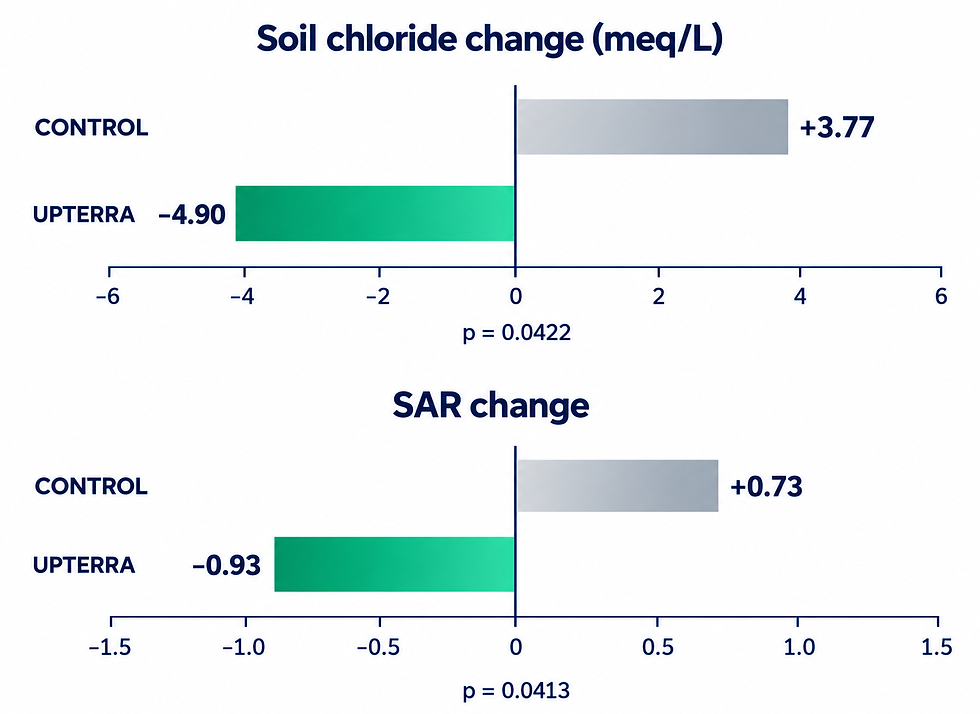
Favorable chloride and SAR response with 25% less irrigation
Soil chloride decreased under UpTerra treatment while increasing in the conventional-water control.
These favorable salt responses occurred while the UpTerra treatment received 25% less irrigation than the conventional-water control.
University of Nevada, Reno Extension | Controlled study | 2026

Salinity indicators declined in commercial cotton fields
Both soluble salts and saturated-paste EC declined in the UpTerra-treated zone while increasing in the control strip.
Oklahoma | Cotton | Field observations

p < 0.05
Lower salinity indicators under controlled saline-soil conditions
UpTerra-treated trees showed lower EC, sodium, SAR, and chloride compared with controls.
The study reports replicated, randomized testing with statistically significant treatment differences at p < 0.05.
MARI Agricultural Research Institution | Hanford, CA | Two years
Less salt re-accumulation deeper in the soil profile
Preliminary depth-resolved measurements showed different EC patterns between treated and control soil profiles.
EC Chloride, sodium, and SAR showed the same directional pattern at selected depths.

MARI Agricultural Research Institute | Hanford, California | 2025


On average, soil grown with UpTerra measures 7.5% better across key structure measures.*
Multi-site field measurements and multi-season soil testing show favorable changes in soil structure, compaction, infiltration, and biological activity under UpTerra treatment.

STRENGTHEN SOIL HEALTH

Improved soil structure across commercial field observations
These measurements reflect the overall response observed across multiple commercial locations, soils, crops, and field conditions.
Multi-site commercial observations | 2025 Data Program

Lower compaction measured
through the soil profileThe results show lower measured penetration resistance across all three reported soil depths.
Multi-site commercial observations

Higher biological activity in a paired seasonal Haney comparison
Treated-soil respiration increased from:
• 19.21 → 53.60 ppm CO₂-C
• +179%
The paired control changed from:
• 39.95 → 28.09 ppm CO₂-C
• −30%
The increase in respiration supports greater or more stable biological activity.
Haney Soil Health Testing | Paired seasonal comparison
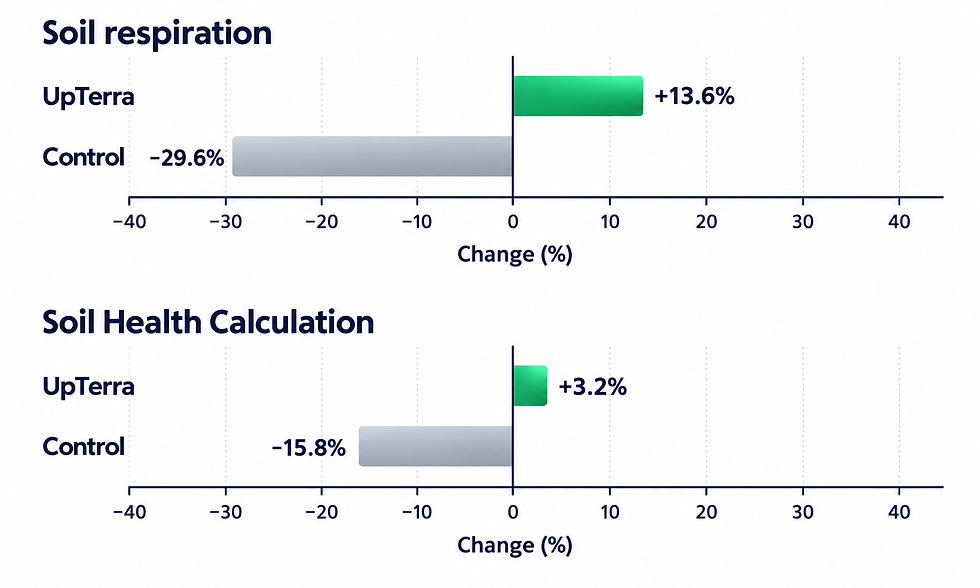
Treated soil respiration increased while control declined
These results support greater stability or improvement in selected soil-health indicators over the multiple seasons.
Haney Soil Health Testing | 2023–2024
Recurring root-zone soil response across commercial fields
Across diverse commercial fields, recurring patterns pointed to improved water movement, retention, and availability throughout the root zone.
Observations included stronger upper-profile water extraction, improved shallow-depth moisture availability, preserved or replenished deeper moisture, and signs of deeper root activity.
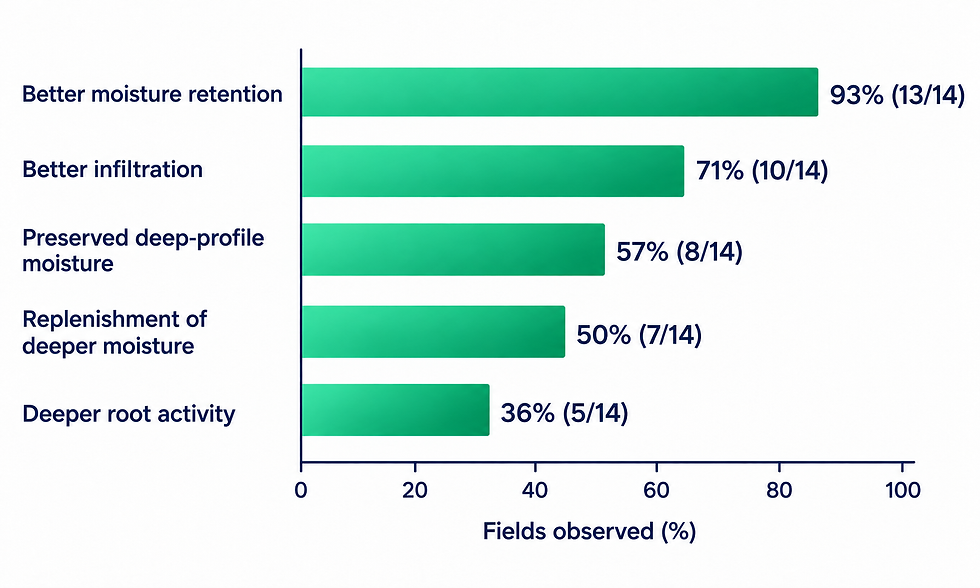
14 commercial fields | Multiple crops and soil types


Soils grown with UpTerra have held 10 to 15% more nitrogen, phosphorus and potassium.*
Multi-site soil measurements and controlled plant-tissue analysis show higher nutrient levels in treated soils and maintained nutrient status under reduced irrigation.

BOOST NUTRIENT UPTAKE
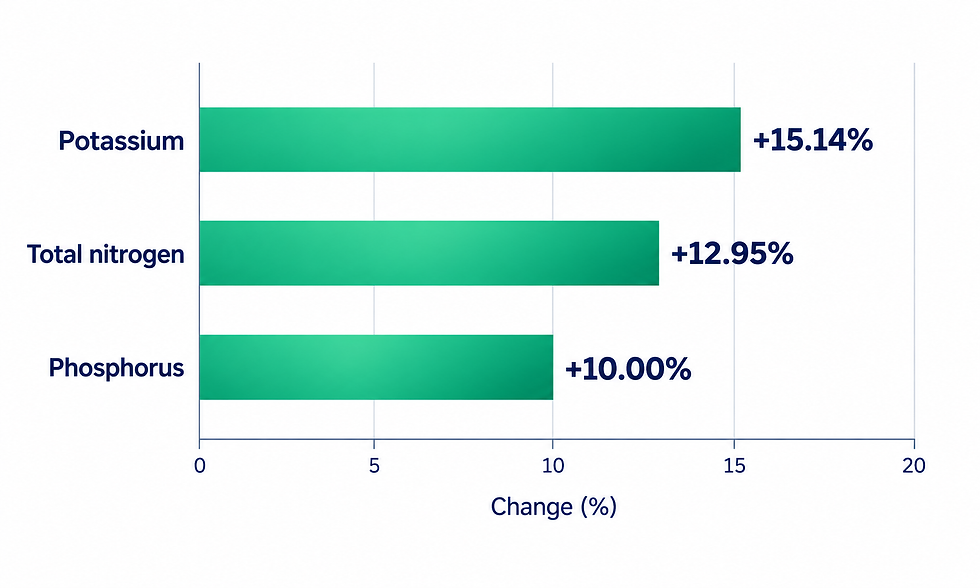
Higher nitrogen, potassium, and phosphorus measured in treated soils
Soil nutrient measurements showed higher levels of three major nutrients in UpTerra-treated soils.
These measurements represent aggregated commercial observations across multiple locations and field conditions rather than a uniform treatment effect at every site.
Corn-associated soil samples | Multi-site commercial observations

Plant-tissue nutrient levels remained comparable under reduced irrigation
UpTerra-treated pea and beet received 25% less irrigation than the conventional-water control.
Despite the irrigation reduction, most measured tissue macro- and micronutrients remained statistically comparable between treatments. The report concludes that reduced irrigation did not broadly impair nutrient uptake.
University of Nevada, Reno Extension | Controlled study | 2026

Significant plant response alongside maintained tissue nutrients
Leaf chlorophyll measurements were significantly higher under UpTerra treatment.
These responses occurred while most measured tissue macro- and micronutrients remained statistically comparable and the UpTerra treatment received 25% less irrigation.
University of Nevada, Reno Extension | Controlled study | 2026

On average, fields grown with UpTerra yield 10% more.*
Commercial crop datasets, matched-field evaluations, and controlled research show maintained or increased crop productivity across multiple cropping systems, together with favorable plant-performance responses.

MAXIMIZE CROP PERFORMANCE

Higher average silage production across commercial observations
Across five corn-silage yield observations, UpTerra-treated fields averaged 15.9% higher corn-silage yield.
These observations span different locations and field conditions and are best interpreted as supportive evidence of crop-productivity response rather than a single controlled treatment effect.
Multi-site commercial observations

Higher lint yield across multiple commercial cotton observations
These observations span different locations, soil types, cultivars, and seasons, the report treats them as supportive evidence of crop productivity and fiber-quality response rather than a single controlled treatment estimate.
Cotton gin data | 2021–2024
Higher grain yield across commercial corn observations
Across six corn-grain yield observations, UpTerra-treated fields averaged 9.8% higher corn-grain yield.

Multi-site commercial observations
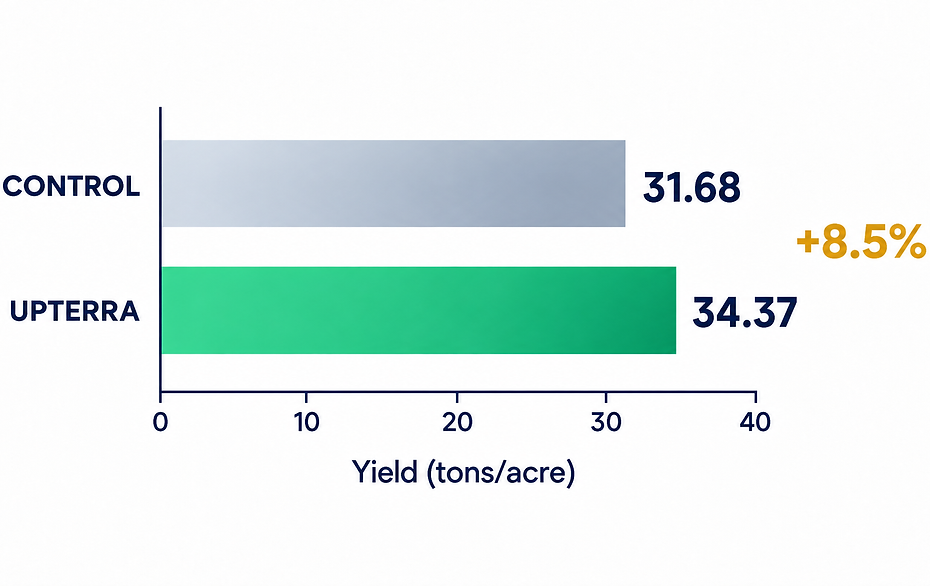
Higher yield while using 20% less irrigation
In a 250-acre treated versus 250-acre control comparison:
• UpTerra: 34.37 tons/acre
• Control: 31.68 tons/acre
• 8.5% higher yield
The UpTerra acreage simultaneously received:
• 19.9% less irrigation
• 35.5% higher water productivity
Howard County, Texas | 500-acre commercial comparison

*Pooled from UpTerra trial and commercial field data collected 2021–2026.
Results vary by crop, climate, water source, irrigation system and farm conditions.

See the results on your farm.
Contact UpTerra today, for benefits all season, year after year.

"We pivoted 50% of the field and left the other 50% as a trial. On the UpTerra side, we definitely saw the results. I base everything on dollars and cents per acre, and we saw around a $180 per acre difference. That came from a 16-pound lint increase and a one-cent increase in the loan price per pound."
— Rod Carver, Western Oklahoma